





Choosing the right B2B e-commerce platform has become a strategic business decision. For manufacturers, wholesalers, distributors, and multi-brand businesses, digital commerce is no longer just about launching a webshop. It is about creating a scalable foundation for growth, efficiency, customer experience, and future competitiveness.
In 2026, the best B2B e-commerce platforms need to support far more than online ordering. They must handle complex product catalogs, customer-specific pricing, availability, integrations, multiple markets, multilingual content, and different sales channels — often across several brands, sites, and countries.
This guide helps you understand what to look for when comparing B2B e-commerce platforms, especially if your business operates in the Nordic market and needs a solution built for complexity.
What is a B2B e-commerce platform?
A B2B e-commerce platform is a digital commerce solution that enables businesses to sell products and services online to other businesses. Unlike traditional B2C platforms, B2B e-commerce platforms must support more advanced requirements such as customer-specific pricing, negotiated agreements, large order volumes, complex product data, multiple warehouses, approval flows, account structures, and integrations with ERP, PIM, CRM, among other systems.
For manufacturers, wholesalers, and distributors, the platform often becomes a central part of the customer journey even though the ERP is often at the center of the business. It gives customers 24/7 access to product information, pricing, stock availability, order history, invoices, spare parts, documents, and repeat ordering.
Why choosing the right B2B e-commerce platform matters
Many B2B companies have already moved parts of their sales online. According to our latest report "Nordic Digital Commerce in B2B 2026" 81% of Nordic B2B companies enable sales through digital channels. But the real challenge is no longer whether to sell digitally. It is how well the digital channel supports the business.
The right platform can help you:
-
Increase digital sales
-
Reduce manual administration
-
Improve customer self-service
-
Strengthen customer loyalty
-
Support sales teams with better data and tools
-
Expand into new markets faster
-
Manage complex product information more efficiently
-
Create a more scalable digital business model
The wrong platform, on the other hand, can create limitations. It may work for a simple webshop but struggle when your business grows, your product catalog becomes more complex, or your customers expect more advanced self-service.
Key requirements for B2B e-commerce platforms in 2026
When comparing B2B e-commerce platforms, start with your business needs and model. A platform that looks attractive in a demo may not be the best fit for a distributor with thousands of products, customer-specific assortments, multiple price lists, several markets, and complex integrations.
Here are the most important areas to evaluate.
1. Support for complex product catalogs
For many B2B companies, the product catalog is one of the biggest challenges. Manufacturers, wholesalers, and distributors often manage thousands or even millions of SKUs, variants, spare parts, accessories, technical specifications, documents, images, and product relationships.
A strong B2B e-commerce platform should make it easy to manage and present complex product information in a way that helps customers find, compare, and buy the right products. Some companies only have a product web and no need for a full B2B e-commerce solution.
Look for support for:
- Large product catalogs
- Product variants and configurable products
- Technical specifications
- Product relationships, such as accessories and spare parts
- Digital assets and product documents
- Customer-specific assortments
- Advanced filtering and search
- PIM integration or built-in product information management
For distributors and multi-brand businesses, strong product data is especially important. Customers need to trust that the information is correct, complete, and relevant to their needs.
2. Customer-specific pricing and agreements
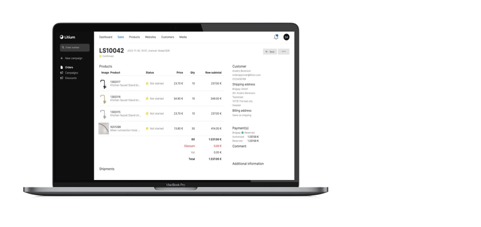
B2B commerce is rarely based on one standard price for everyone. Customers may have individual agreements, discounts, volume pricing, contract pricing, or market-specific price lists.
A B2B e-commerce platform must be able to show the right price to the right customer at the right time.
Evaluate whether the platform supports:
- Customer-specific pricing
- Contract-based pricing
- Volume discounts
- Campaign pricing
- Market-specific pricing
- Role-based access to prices
- ERP-driven pricing logic
- Real-time price updates
This is one of the clearest differences between B2C and B2B e-commerce solutions. In B2B, pricing is often deeply connected to the ERP system, sales agreements, and customer relationships.
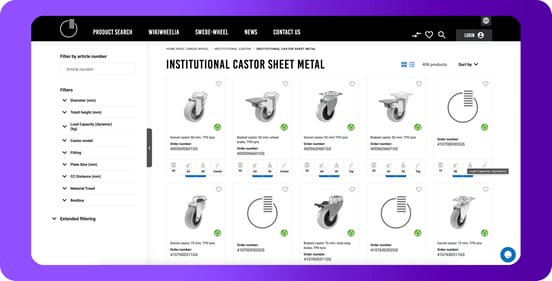
Litium offer all logics to handle customer specific pricing and agreements. Read how Swede-Wheel gives B2B customers access to tailored price lists, stock levels and documentation through its customer portal. https://www.litium.com/case/swede-wheel
3. Inventory management for B2B
Inventory management for B2B is about more than showing whether a product is in stock. Customers often need to know availability by warehouse, expected delivery dates, backorder options, lead times, and whether partial deliveries are possible.
For manufacturers, wholesalers, and distributors, stock visibility is a major part of the customer experience.
A strong platform should support:
- Real-time stock availability
- Warehouse-specific inventory
- Delivery estimates
- Backorder handling
- Lead times
- Partial deliveries
- ERP and warehouse management integrations
- Stock visibility based on customer, market, or channel
Good inventory data reduces unnecessary calls and emails to customer service. It also helps customers plan purchases more effectively.
4. Multi-site e-commerce capabilities
Many B2B companies operate more than one site. You may have several brands, markets, business units, customer portals, or local websites. Managing each site separately quickly becomes inefficient.
Multi-site e-commerce allows you to manage several sites, markets, or brands from one platform while still adapting content, assortment, pricing, and language locally.
This is especially important for Nordic companies expanding across Sweden, Norway, Denmark, Finland, and beyond.
Look for multi-site support such as:
- Several websites in one platform
- Brand-specific sites
- Market-specific sites
- Shared product data across sites
- Local content and campaigns
- Different assortments per site
- Different pricing and availability per market
- Central governance with local flexibility
A good multi-site e-commerce setup gives you both control and speed. You can reuse what should be shared and adapt what needs to be local.
5. Multi-language e-commerce
For Nordic and international B2B companies, multi-language e-commerce is a must. Customers expect to find product information, navigation, documentation, and support content in their local language.
But multi-language commerce is not only about translation. It is about managing local relevance at scale. For example, BE Group built a platform adapted for both the Swedish and Finnish markets, with room for local adaptations while maintaining one consistent company experience.
Evaluate whether the platform supports:
- Multiple languages
- Localized product information
- Market-specific content
- Translation workflows
- Local currencies and formats
- Country-specific terms and conditions
- SEO and AEO optimization for different languages
- Consistent brand experience across markets
For manufacturers, wholesalers, and distributors, multilingual product data can become a major operational challenge. The right platform should make it easier to manage translations without losing control of quality or consistency.
6. Integration with ERP, PIM, CRM, and other systems
A B2B e-commerce platform cannot operate in isolation. It needs to connect with the systems that already run your business. For most B2B companies, the ERP system is especially important. It often controls pricing, inventory, customer data, orders, invoices, and delivery information.
Important integrations include:
ERP
PIM
CRM
WMS
Payment providers
Shipping and logistics systems
Marketing automation
Business intelligence tools
Customer service systems
When evaluating e-commerce solutions, ask how integrations are managed. Are there standard connectors? Is there an API-first architecture? Can the platform support your current system landscape as well as future needs? It can be very expensive to built an integration. At Litium we have a partnership with Monitor with a ready made integration. Read more about this here: https://www.litium.com/blog/litium-and-monitor-erp-enter-into-partnership
A modern B2B platform should make integration easier, not become another isolated system.
7. Self-service for B2B customers
B2B buyers increasingly expect the same level of convenience they experience as consumers. But they also have more advanced needs.
A B2B e-commerce platform should make it easier for customers to manage everyday tasks themselves.
Common self-service features include:
- Order history
- Repeat ordering
- Saved carts
- Quick order
- Quotes
- Invoices
- Delivery tracking
- Product documents
- Spare parts search
- Returns and claims
- Account management
- User roles and permissions
Self-service does not replace sales. It frees sales and customer service teams from repetitive tasks so they can focus on more valuable customer interactions.
“Self-service is critical to our business. We need to provide customers with the right information 24/7,” says C-G Hanson, Digital Manager at Nordic Waterproofing. “Our customer journey often happens in two steps—first online research, then an in-store purchase. Or the other way around. That’s why our digital presence needs to be just as strong as our products on the shelf.”
8. Support for complex buyer organizations
B2B customers are often organizations, not individuals. One customer account may include several users, roles, departments, locations, and approval levels.
A B2B wholesale platform should support complex account structures and buying processes.
Look for features such as:
- Company accounts
- Multiple users per account
- Role-based permissions
- Approval workflows
- Budget limits
- Cost centers
- Shared carts
- Order templates
- Customer-specific catalogs
This is especially important in e-commerce for distributors, where customers may have recurring purchasing patterns, internal approval processes, and different users with different responsibilities.
9. Scalability and performance
Your platform needs to support where your business is going, not only where it is today.
As your digital channel grows, the platform must handle more products, customers, orders, markets, content, integrations, and traffic.
Ask questions such as:
-
Can the platform scale with growing order volumes?
-
Can it support more markets and sites over time?
-
Can it handle large product catalogs without performance issues?
-
Can it support both B2B and B2C needs if required?
-
Is it flexible enough for future business models?
-
How is performance handled during peak periods?
Scalability is not just a technical issue. It affects your ability to launch faster, grow internationally, and respond to changing customer needs.
10. Platform migration and future readiness
Many B2B companies evaluating platforms in 2026 are not starting from zero. They are replacing an older platform, consolidating several systems, or moving from a custom-built solution to a more scalable commerce platform.
A platform migration should not only recreate what you already have. It should help you improve the digital customer journey and prepare for future growth.
Before migrating, consider:
✔️ What should be kept, improved, or removed?
✔️ Which customer journeys need to be simplified?
✔️ Which integrations are business-critical?
✔️ What product data needs to be cleaned or enriched?
✔️ Which markets, brands, or sites should be included first?
✔️ How can the migration reduce complexity over time?
A successful migration starts with clear priorities. Focus on the business value you want to create, not only the technical platform replacement.
Questions to ask when comparing B2B e-commerce platforms
Make sure you take the time to really think about what you need. When evaluating different B2B e-commerce platforms, use these questions to guide your decision:
- Can the platform handle our product complexity?
- Does it support customer-specific pricing and agreements?
- Can it integrate with our ERP and other business-critical systems?
- Does it support multi-site e-commerce?
- Can we manage multiple languages and markets efficiently?
- How does it support inventory management for B2B?
- Can customers manage orders, invoices, and repeat purchases themselves?
- Does it support complex account structures and approval flows?
- How scalable is the platform as our digital sales grow?
- How flexible is it for future business models, AI, and automation?
- What level of control do we have over data, hosting, and compliance?
- How much can we manage ourselves without relying on development for every change?
The best platform is not always the one with the longest feature list. It is the one that fits your business model, your customers, your system landscape, and your growth ambitions.
Common mistakes when choosing a B2B e-commerce platform
Many platform projects become more complex than expected because the evaluation focuses too much on the webshop and too little on the business behind it.
Avoid these common mistakes:
❗ Choosing a platform built mainly for simple B2C commerce
❗ Underestimating product data complexity
❗ Treating ERP integration as a technical detail
❗ Ignoring customer-specific pricing requirements
❗ Forgetting multi-language and multi-site needs
❗ Migrating old complexity instead of simplifying
❗ Focusing only on launch instead of long-term scalability
❗ Not involving sales, customer service, IT, and operations early enough
A B2B e-commerce platform affects many parts of the organization. The decision should reflect that.
What makes a good B2B e-commerce platform in 2026?
A good B2B e-commerce platform in 2026 should combine flexibility, scalability, integration capabilities, and strong support for complex commerce processes.
For manufacturers, wholesalers, and distributors, the platform should help you:
- Sell more efficiently
- Serve customers better
- Reduce manual work
- Manage product information at scale
- Support multiple markets and languages
- Connect commerce with ERP and business systems
- Enable both digital self-service and stronger sales relationships
In short, the platform should not only support online transactions. It should support the way your business actually works.
Choosing a platform for Nordic B2B commerce
Nordic B2B companies often operate across several markets, languages, and customer segments. Many also have complex product structures, high expectations on reliability, and a strong need for integration with local ERP and business systems.
That makes platform choice especially important.
Whether you are a manufacturer selling spare parts, a wholesaler managing large assortments, or a distributor serving many customer groups, your e-commerce platform should give you the control, flexibility, and scalability needed to grow.
Benchmark and look at insights from more than 900 decision makers in B2B in the Nordics. Litium report "Nordic Digital Commerce in B2B 2026" is full of insights to learn from. You find the report here.

Final thought: choose for your needs and complexity, not just for launch
Launching a B2B webshop is one step. Building a digital commerce platform that supports long-term growth is something bigger.
The right B2B e-commerce platform should help you meet today’s customer expectations while preparing your business for what comes next: more automation, more personalization, more AI-driven buying journeys, and more connected digital sales processes.
For B2B manufacturers, wholesalers, and distributors, the platform decision in 2026 is not only a technology decision. It is a business decision.
Choose a platform that can handle your complexity — and help turn it into a competitive advantage.
Read more in our latest report about the current state, driving forces and results in the Nordic B2B commerce:
