



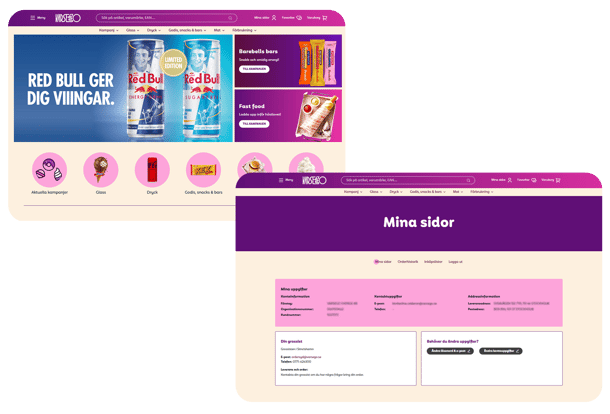


According to Litium's Nordic Digital Commerce in B2B 2026 report, 91 percent of wholesalers in the Nordics have digital sales channels today. But having a webshop and having the right webshop are not the same thing. Platforms built for B2C, or for simple B2B sales, rarely handle what a wholesaler actually needs: customer-specific pricing per contract account, tens of thousands of SKUs with frequent updates, complex order flows, and a customer base that expects exactly the same terms online as they have negotiated with the sales rep.
There is a reason Varsego cut their manual work by 80 percent, grew their customer base by 22 percent, and increased webshop revenue by 38 percent in the first year. It is not about which webshop they chose. It is about which features the platform had and how those features connected to the rest of the business.
This guide walks through the six features that actually determine whether an e-commerce platform works for wholesale.
1. Customer-specific pricing and contract logic in real time
A wholesaler rarely has a single price per item. Every contract customer has their own prices, their own discount structures, sometimes volume tiers and time-limited campaign prices that live in the ERP system. The webshop has to reflect that exactly, for every customer, from the moment they log in.
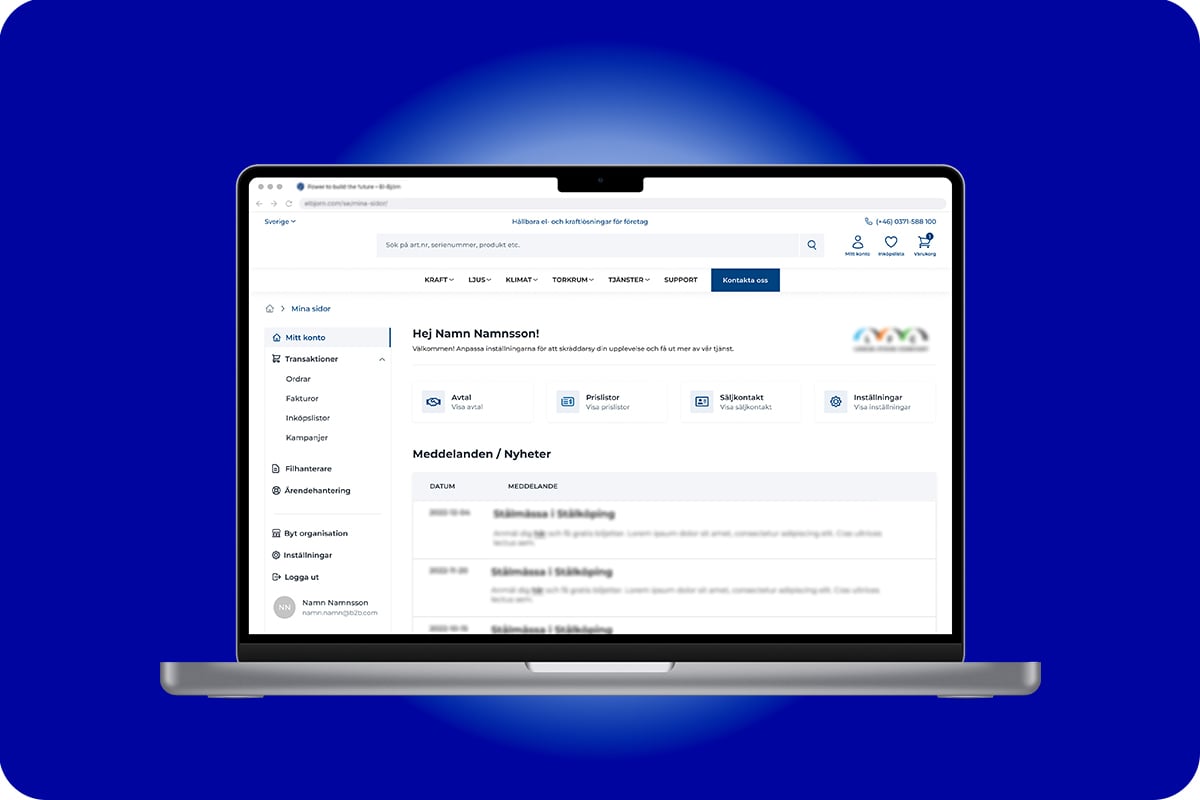
That means the platform must handle:
- Display of customer-specific pricing immediately on login, without manual configuration per customer
- Real-time retrieval of contract prices via API from the ERP, not scheduled batch exports
- Volume discounts and quantity tiers visible at checkout before the order is placed
- Campaign prices per customer or customer group with automatic start and end dates
- The option to hide prices from non-logged-in visitors, or show list prices with a clear prompt to log in
If the platform synchronises prices once a day, it is not enough for the wholesale business. A contract customer who sees the wrong price at 2 pm because the batch ran at 3 am calls your sales rep instead of completing the purchase. That cost is hard to quantify but easy to feel.
Ask the platform vendor directly: are prices real time via API calls, or scheduled exports? That answer tells you more about the system than any feature list does.
2. PIM for large and frequently updated product catalogues
A wholesaler can have tens of thousands of SKUs. Many of them are updated frequently: prices change, technical documentation is revised, new variants are added. Without a structured way to manage product information, it becomes manual work that does not scale with the assortment.
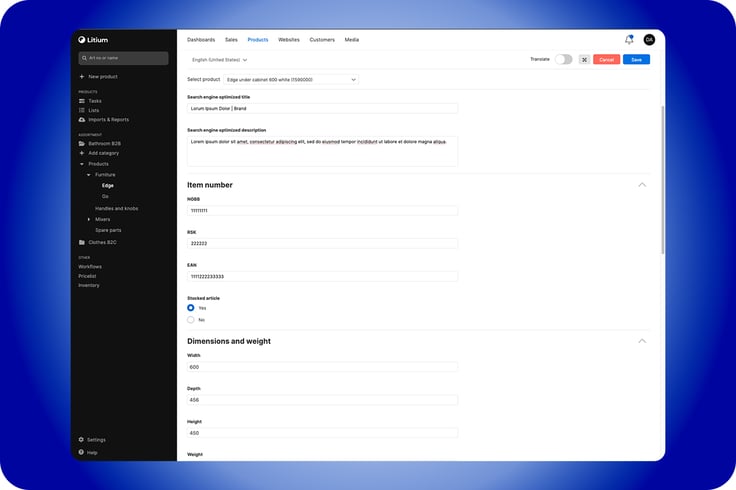
Varsego chose Litium's e-commerce platform specifically because it included a built-in PIM. That was decisive in being able to manage a broad and frequently updated assortment without having to synchronise data between separate systems.
A PIM function for wholesalers needs to handle:
- Structured product attributes per category with the ability to filter and search the assortment
- Technical documentation, datasheets and CAD files linked directly to the item
- Variant handling for items with many combinations of size, colour or specification
- Multilingual content per market without duplicating the product registry
- Bulk import and export of product data with clear error handling
The division of responsibility is clear: the ERP owns master data such as item numbers, purchase price and stock position. PIM owns the presentation: what the customer sees, reads and downloads. It is a structure that holds regardless of how the assortment grows.
3. ERP integration that works from day one
There is an important distinction between a possible integration and a finished integration. A possible integration means the platform has an API and that it is technically possible to connect to your ERP. That can take many months to build from scratch and then requires ongoing maintenance at every version update of both systems. A finished integration is documented, tested and maintained by the vendor or a certified partner, and works from day one.
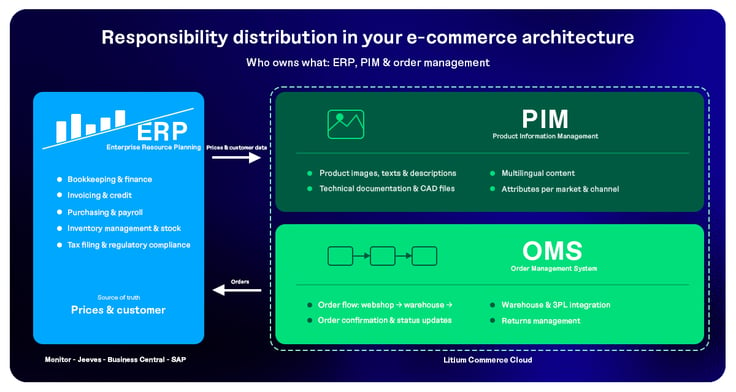
For a wholesaler, the following data flows between the ERP and the webshop continuously:
- Stock levels per item and warehouse location in real time
- Contract prices per customer and customer group
- Customer records with contacts, delivery addresses and credit limits
- Orders and order confirmations in both directions
- Invoices and payment status
- Delivery status and tracking information
If any of those flows require manual handling, it is a cost that grows linearly with order volume. That is exactly what Varsego eliminated when they connected their webshop to the ERP data without middleware or manual steps.
Litium's ERP integrations for Monitor, Jeeves, Business Central and SAP are built and maintained by Litium or certified partners. Always ask who owns the maintenance and how the integration is tested when either system is updated.
4. Self-service and customer portal
Contract customers at a wholesaler do not want to call to check stock status, retrieve an invoice or place a recurring order. They want to do it themselves, when it suits them, without involving your sales team. That is an expectation driven by B2C experiences but one that B2B buyers now bring into their professional purchasing.
Tingstad solved it with their customer portal: customers could manage their purchases on their own, which reduced pressure on the sales team and improved conversion directly. Swede-Wheel saw a 70 percent revenue increase after opening a digital customer portal to their contract customers.
A customer portal for wholesalers should include:
- Order history with the option to reorder directly from past orders
- Invoices with downloadable PDF and payment status
- Real-time stock status on the items the customer buys
- Quick order via item number or CSV import for customers with their own purchasing systems
- User management within the customer account, with separate roles for buyers, decision-makers and approvers
- Quote requests handled and tracked digitally
Self-service frees up sales resources. It does not replace the customer relationship. It lets the sales team spend their time on deals that actually require them.
5. Order management for wholesale volumes and complex logistics
A wholesaler's order flow is more complex than a standard B2C order. It can involve split deliveries to multiple addresses, customers with blocked items, credit-managed customers, and orders that require approval before they are confirmed. A platform that cannot handle that logic forces manual handling in exactly the situations where it matters most.
The platform needs to handle:
- Split deliveries and backorders with automatic status updates to the customer
- Multiple delivery addresses per customer account without manual administration
- Credit handling connected to the ERP's customer limits, with automatic logic for customers who have exceeded their credit
- Order confirmation and delivery tracking directly in the customer portal
- Connection to 3PL and own warehouses with real-time information on stock status and picking
- Minimum order, shipping logic and special contract terms per customer group or delivery method
This is the kind of logic that does not show up in a demo environment but determines whether the system works in production. Always ask for a reference customer with similar order volume and logistics complexity before signing.
6. Support for expansion and an architecture that holds as you grow
Many wholesalers start with one country and add more markets within five years. A platform that cannot handle expansion forces rebuilds, separate instances or manual workarounds. That costs more than choosing right from the start.
A platform built for growth handles:
- Separate price lists per market and currency with automatic currency handling
- Market-specific content and product descriptions without duplicating the product registry
- VAT rules per country including EU OSS rules for cross-border B2B trade
- Multiple legal entities in the same platform instance with separate customer and order registries
- Local payment methods per market
Beyond internationalisation, the platform's technical architecture determines how much it can handle as traffic, assortment and integrations grow. A headless and API-first architecture gives the freedom to plug in specialised systems for search, personalisation and payment via open APIs without being locked into the platform's built-in options. With 99.9 percent uptime in production, the webshop is a critical sales channel that cannot go down.
Tingstad specifically chose a platform that future-proofed their infrastructure for increased digital demand. That is an investment in where the ceiling is, not just in what you need today.
Summary: six features to demand
An e-commerce platform for wholesalers is not a webshop with a price list. It is a system that mirrors complex business logic, integrates with critical infrastructure and serves contract customers who have high expectations and low tolerance for errors.
The six features to evaluate before a platform decision:
- Customer-specific pricing and contract logic in real time via API to the ERP
- Built-in PIM for managing large and frequently updated product catalogues
- Finished ERP integrations that are documented and maintained by the vendor
- Customer portal with self-service for orders, invoices and stock status
- Order management that handles split deliveries, credit logic and 3PL connections
- Support for international expansion and a headless architecture that scales with the business
Vendors sell on feature pages and demo environments. You should buy on reference customers with similar complexity, certified ERP integrations and a clear answer to who owns the maintenance when both systems are updated.