





AI assistants have changed how B2B buyers search, evaluate, and decide. Instead of typing “best industrial pump for hot acid”, they now ask ChatGPT, Copilot, or Gemini directly.
The result? Buyers don’t see your website. They see the answer.
If that answer is based on someone else’s data, that’s a missed opportunity.
If it’s based on your data, clean, structured, and credible, that’s visibility at a whole new level.
This guide shows how to make your B2B company truly visible to AI models. You’ll learn how to prepare your product data, content, and website so that AI understands, trusts, and reuses what you publish.
1. Why AI Visibility matters in B2B
Classic SEO made sure humans could find you. AI visibility makes sure machines understand you.
When AI models generate answers, they pull from thousands of sources, giving preference to content that:
- is structured and labeled clearly
- shows consistent relationships between entities (like brands, categories, and products)
- comes from trustworthy, regularly updated sites
If your content isn’t optimized for that, your company effectively disappears from AI-generated results.
B2B buyers expect quick, accurate answers. They want specs, compatibility, standards, and case evidence, not marketing fluff. AI doesn’t “rank pages” anymore. It builds knowledge from data it trusts. That’s why your product information, structure, and markup are now your most powerful marketing assets.
2. Make your products machine-readable
Everything starts with data. You can’t write your way out of poor product information. Before thinking about keywords or content, make sure your product catalog is machine-ready.
Each product should include:- product name, type, and application
- materials, dimensions, and weight
- GTIN, SKU, and manufacturer info
- compatibility and standards (ISO, EN, DIN, etc.)
Use a Product Information Management (PIM) system that enforces structure and ownership. It should prevent missing or conflicting data and keep units consistent: millimeters, kilograms, liters. AI models prefer clean, normalized information.
Then go beyond attributes. Add relationships:
- what each product replaces or is replaced by
- which accessories fit or connect
- what it’s used in or compatible with
These relationships turn a static catalog into a living dataset. It’s what allows AI to connect the dots between components, systems, and industries.
Finally, build governance. Assign ownership for every attribute group, automate validation, and include both datePublished and dateModified metadata. AI rewards data that looks alive.
3. Mark up correctly with schema and JSON-LD
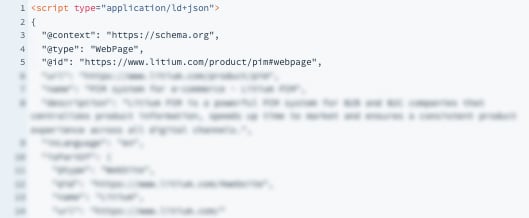
Structured data is the bridge between your content and the model’s understanding. JSON-LD markup tells machines exactly what’s on the page.
For product pages, include:Product: name, description, GTIN, SKU, dimensions, and brandOffer: availability, price, and conditionOrganization: your company’s verified identityAggregateRating: only if reviews are real and verified
Article: with headline, description, and publication datesFAQPage: when the page truly contains questions and answers
Avoid duplicate markups from overlapping widgets or plugins. Each page should have a single, clean, validated JSON-LD block.
This isn’t about gaming search engines. It’s about communicating in the data language AI understands best. Well-structured markup helps LLMs know what your information means, not just what words it uses.
4. Build a knowledge graph that AI can follow
Think of your website as a map. Each product, brand, and use case is a “node.” The links between them, “accessory,” “replacement,” “compatible with”, are the edges that show relationships. That’s what a knowledge graph really is: a connected web of meaning.
Start with a clear content architecture:- create hub pages for each brand, category, and product family
- link out to detailed product pages and back to the hub
- connect related products horizontally (“also fits”, “works with”)
Add contextual metadata like breadcrumbs (BreadcrumbList) and overview lists (ItemList). These help AI models understand hierarchy and proximity.
- External links also matter. Cite relevant standards, certifications, or specifications:
- ISO, GS1, or CE documentation
- external supplier databases
- industry associations or safety bodies
Every connection strengthens your authority graph and tells AI that your content reflects verified knowledge.
5. Write for extraction, not decoration
The most valuable sentences are the ones that can stand alone in an AI-generated answer. That doesn’t mean writing like a robot. It means combining human clarity with machine precision.
Keep this pattern in mind:- Describe the problem your customer faces.
- Provide the solution in 2-4 actionable steps.
- Add proof: a short checklist, data point, or example.
- Close with a next step or call to action.
For example:
“To select the right mechanical seal, start by defining the fluid and temperature. Match the material and pressure rating. Confirm dimensions against the pump model. Document the part number and replacement options.”
Readable, factual, and reusable: the perfect formula for both humans and models.
Use short paragraphs, clear H2s, and consistent units. Avoid unnecessary fluff words. If it sounds natural when read aloud, it’s likely machine-friendly too.
Build entity-based internal linking
Internal linking is how you teach both readers and machines what belongs together. Generic “learn more” links are invisible to AI. Descriptive anchors are gold.
Smart linking strategy::- link from every product page to its brand or category hub
- link hubs back to detailed guides and reference content
- connect related products with explicit relationships
- “Compatible 13 mm chuck key for model X”
- “Seal kit for acid pump series Y”
- “Replacement housing for Z200 filter”
Each of those anchor texts tells AI something new about your content’s semantics. Over time, it builds a network of meaning that resembles a knowledge graph, exactly what LLMs are trained to navigate.
Use FAQs as an AI accelerator
FAQs are an underrated powerhouse. They provide clear, concise question-answer pairs: the exact format language models love.
Write FAQs like this:- one focused question, one complete answer
- natural phrasing (“How do I install…”, “Which model replaces…”)
- short and factually correct
- create a dedicated FAQ hub page with
FAQPagemarkup - include product-specific FAQs for installation, compatibility, and maintenance
Keep them current. Review every quarter or when product specs change. Outdated answers confuse both humans and AI.
Measure and iterate
AI visibility isn’t measured by traffic alone. You need new metrics that reflect machine understanding.
Data quality KPIs:- percentage of product pages with complete schema
- consistency of attributes across variants
- frequency of metadata updates
- how often your data appears in AI answers (via scenario testing
- brand mentions or citations in generative outputs
- engagement from AI-integrated tools (assistants, chatbots, etc.)
- validate all markup quarterly
- fix broken links and stale entities
- re-evaluate internal linking patterns
Think of it like tuning an instrument. A small change in structure or metadata can make a big difference in how AI interprets your content.
The Nine-Step model for sustainable AI visibility
- Audit product data: fill gaps and clean duplicates.
- Normalize naming, units, and formatting.
- Create hub pages for brands, categories, and product families.
- Implement JSON-LD for
Product,Offer,Organization,Article, andFAQPage. - Add breadcrumbs and
ItemListto categories. - Build entity-based internal links with descriptive anchors.
- Publish a structured FAQ bank connected to deep-dive content.
- Run a 90-day update and validation cadence.
- Measure visibility, identify weak spots, and iterate.
Repeat this cycle, and your site will evolve from a content repository to an AI-readable dataset. That’s the level of maturity where models don’t just find you: they rely on you.
Conclusion: The new frontier: from findable to answerable
AI visibility isn’t a separate discipline. It’s the next stage of great digital commerce. Everything that made strong B2B websites valuable before: clean data, consistent structure, verified truth: still applies. The difference is the audience.
Now, part of your audience doesn’t have eyes. It has a language model.
That model doesn’t care about design trends or brand colors. It cares about clarity, accuracy, and relationships. If your information can be parsed, trusted, and reused, you win.
This is where the best B2B companies are heading:- data as an asset
- structure as a differentiator
- and truth as a marketing advantage
When your catalog speaks the language of AI, you don’t just compete for clicks. You compete for inclusion in the world’s fastest-growing source of answers.
And the companies that invest early? They won’t just be found.
They’ll be quoted.